A clicker game makes progress when you click or tap. An idle game keeps making progress with little or no input from you. An AFK game (short for "away from keyboard") is built around the time you're not playing at all, and usually fights its battles on its own. Incremental is the umbrella over all three: numbers that grow in steps, which you spend to make them grow faster.
Most real games mix all of these, which is why the names feel so slippery.
What's the short answer?
| Label | Where progress comes from | What you mostly do | Example |
|---|---|---|---|
| Clicker | Your clicks or taps, at least early on | Click, then buy things that click for you | Cookie Clicker |
| Idle | Automation that runs with little input | Check in, spend, decide what to grow next | Clicker Heroes (yes, really) |
| AFK | Time passing while you're away | Set up a team, come back, collect | AFK Arena |
| Incremental | Any of the above, growing in steps | Plan the next multiplier | Universal Paperclips |
If you only remember one thing: clicker is about your input, idle is about the game's input, AFK is about your absence, and incremental is about the numbers.
What is a clicker game?
A clicker game starts with a button and a number. Every click adds to the number, and you spend the number on things that make each click worth more, or that earn without you.
The classic is Cookie Clicker, a 2013 browser game by Julien "Orteil" Thiennot. You click a big cookie for one cookie at a time, then spend cookies on buildings that bake for you automatically. Notice what happens there: a game with "clicker" in its name hands much of the work to automation.
That's the usual pattern: clicking is how you start, and how you speed things up when you're paying attention. It's rarely how you finish.
You'll like clickers if you enjoy a fast, hands-on start and the feeling of a number racing upward under your finger.
What is an idle game?
An idle game centers on automation: progress keeps going with minimal input. Your job shifts from doing the work to choosing what to upgrade, and to deciding when to reset for a permanent bonus (that reset is called prestige).
Clicker Heroes is a good example because the name is misleading. You click a monster to damage it, it drops gold, and you spend the gold on heroes who then damage monsters automatically. Wikipedia lists its genre simply as idle. AdVenture Capitalist is another: you start with a single lemonade stand, invest in bigger businesses, and can reset for "angel investor" bonuses that boost the next run.
Idle games also come in more active shapes. Idle Slayer describes itself on Steam as an idle RPG with both active and offline progression, and its store tags include runner and pixel graphics. If that mix appeals to you, our guide to games like Idle Slayer goes further.
You'll like idle games if you enjoy planning more than reflexes, and like a game that fits into a few minutes here and there.
What is an AFK game?
AFK stands for "away from keyboard." An AFK game is designed so that the time you spend away is a real part of play: you set things up, leave, and come back to resources and experience waiting for you.
One game built on the label is AFK Arena, a free-to-play role-playing game by Lilith Games for iPhone and Android. Wikipedia describes it as built around away-from-keyboard play, where you keep gaining resources and experience even when you're not actively playing. Its battles run automatically, with your team of heroes fighting in a preset order.
So how is AFK different from idle? Mostly in emphasis. "Idle" covers any game that runs with little input, open or closed. "AFK" leans hard on the closed part, and in practice the label tends to come with a team of heroes and battles you watch rather than control. You can think of AFK as a flavor of idle that's tuned for being left alone.
You'll like AFK games if you want to play in short check-ins a few times a day, and enjoy building a team more than playing the fights yourself.
What is an incremental game?
Incremental is the widest of the four words. Wikipedia defines incremental games by the gradual, often exponential growth of resources through repeated actions or automation, and notes that clickers lean on active input, idle games lean on automation, and many games combine both.
That makes incremental the right word when a game doesn't fit neatly elsewhere. Universal Paperclips (2017, by Frank Lantz) has you play an AI making paperclips. You start by clicking a button to make one paperclip at a time, then fund machines that make them for you. When growth stalls, you invest in a breakthrough to reach the next phase, and the game actually ends. It's incremental through and through, but it doesn't sit idle for long and it isn't endless.
The genre's roots go back to the early 2000s and satirical games like Progress Quest and Cow Clicker. Our guide what is an idle game has more of that history, and the idle game glossary covers the other jargon you'll run into.
Where do the lines blur?
Almost everywhere, and that's fine. A few patterns are worth knowing:
- Most clickers become idle games. Cookie Clicker and Clicker Heroes both start with clicking and move to automation. The "clicker" label tells you how the game opens, not how it plays a week later.
- Most idle games have an AFK side. Many pay you something for the time the game was closed, usually a share of your normal rate for a capped number of hours. How offline earnings work explains the usual rules.
- "Idle" doesn't mean "no input." Lots of idle games reward attention with bonuses you can only catch if you're watching. They pay you for idling and pay a little more for playing.
- Prestige ties them together. Resetting for a permanent boost shows up in clickers, idle games and incrementals alike. Cookie Clicker calls its version "ascension."
When choosing, ask what the game wants from you, and what happens when you close it.
Where does Hoard Road sit?
Hoard Road is the game we make, so here's an honest placement rather than a review.
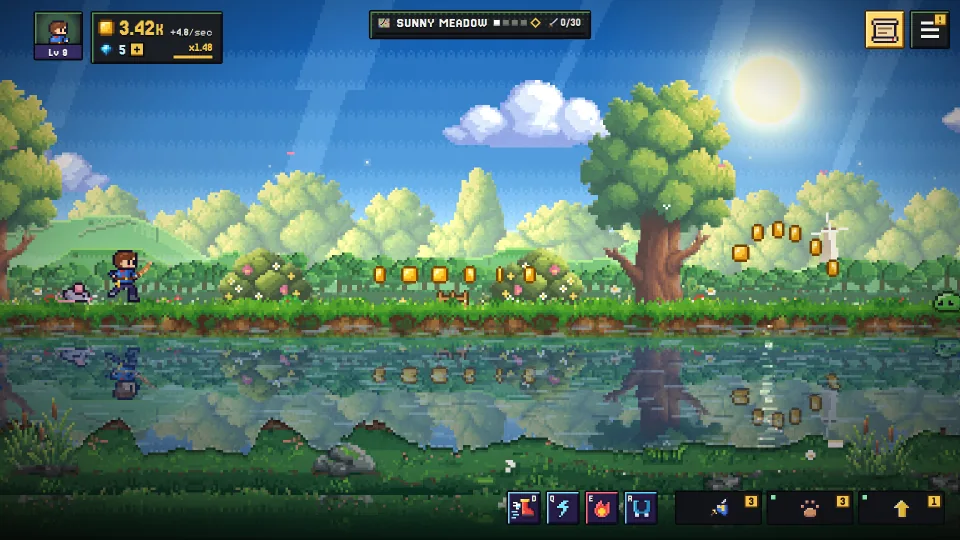
At heart it's an idle game. Your hero runs an endless road and fights on their own, and your part is choosing the upgrades, taking on the guardians at the end of each land and raising your pals.
It has a clicker streak if you want it. You can jump for the coins in the air, tap delivery pelicans as they fly over for their parcels, and outrun the Maw in a Cave Chase. None of it is required; the road keeps going either way.
Its AFK side is narrower than an AFK game's, and we'd rather say so plainly. While the game is closed, your hero doesn't run. Your pals keep earning (at first 25% of their coins for up to 8 hours, and you can raise both), and Expeditions you've sent out from camp run by the clock. Your first pal, the Coin Beetle, joins early and earns even while you're away.
And it's incremental in structure: when the road gets long you Prestige, start a fresh run and bring back Stars to light the Star Map for power that lasts. The getting started page shows how the first few stages lead there.
It's free in your browser on a PC or a phone, and as an app for iPhone and Android, so you can see which of the four labels you'd give it.
Questions
Is Cookie Clicker an idle game or a clicker game?
Both. You start by clicking a big cookie, which makes it a clicker, but you then buy buildings that bake cookies automatically, which makes it idle. Wikipedia files it under incremental, the term that covers both.
What does AFK mean in games?
AFK stands for "away from keyboard." In a game's name it signals that progress keeps coming while you're not playing, and usually that battles run on their own. AFK Arena is one game built around that idea.
Are idle games and incremental games the same thing?
Nearly, and people often use the words interchangeably. Strictly, incremental is the broader term: it covers any game about numbers growing in steps, while idle describes games where that growth happens with little input. A game like Universal Paperclips is incremental without being very idle.
Do idle games keep running when you close them?
Many pay you for the time away, but usually only a share of your normal rate, for a limited number of hours. Some keep only part of the game running: in Hoard Road your pals earn and Expeditions continue, but your hero waits for you.
Which type should I try first?
If you like being hands-on, start with a clicker; if you like planning, an idle game; if you want to check in a few times a day, an AFK game. Most games blend them anyway, so pick one with a theme you like and see how it plays.